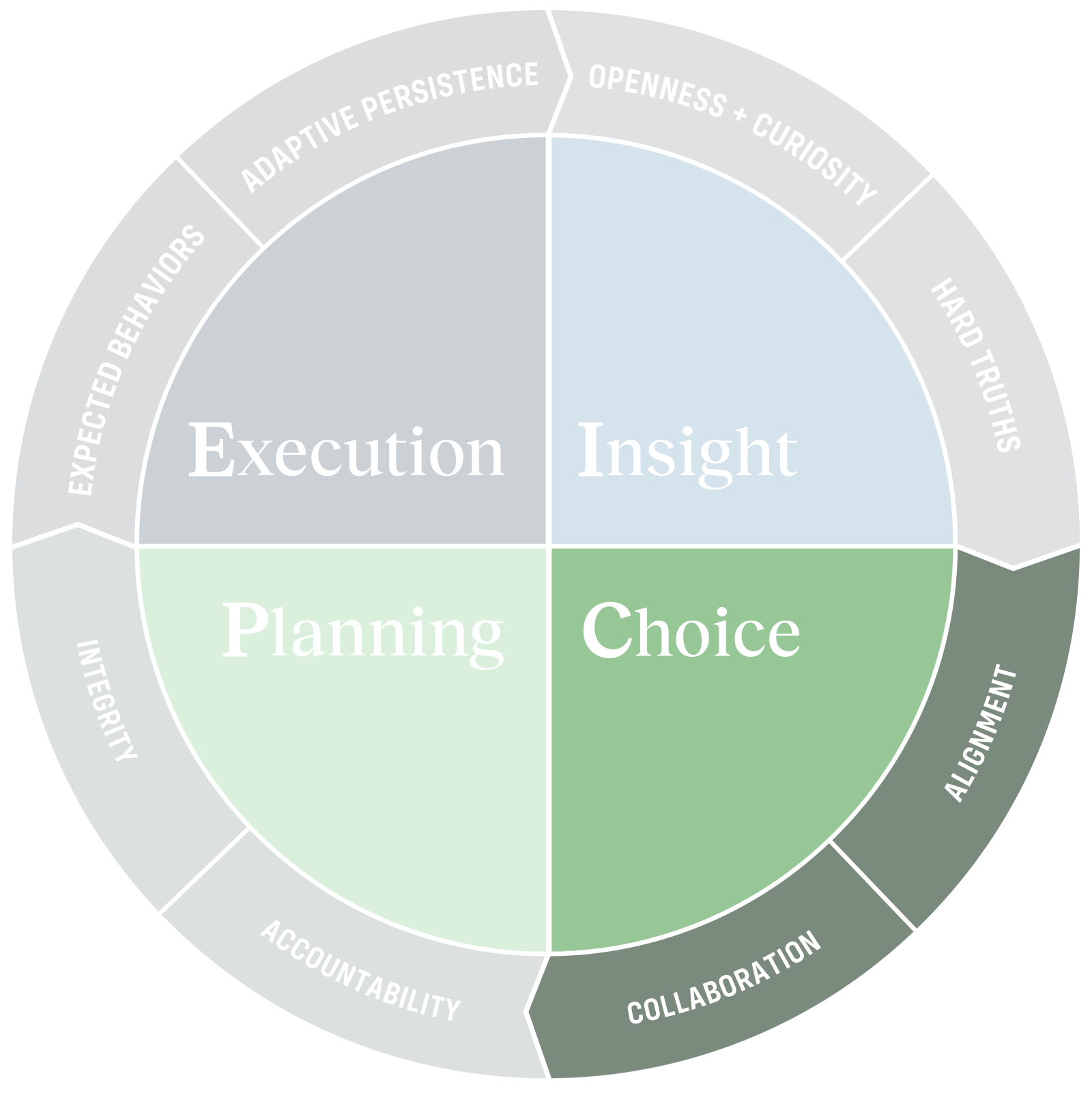
If Insights on SWOT’s are the DNA of building a great strategy, then Choice is the core discipline that makes strategy impactful. And while getting sharp and clear insights is tough, deciding and making clear choices is actually the thing that trips up many of the strategic plans that we’ve seen.
So why is making choices so difficult? Let’s start with us as individuals. Not only are we not perfect, but we can also be unwittingly imperfect in some specifics ways that affect the way we make decisions. They’re called cognitive biases. Confirmation bias – where we tend to select only the facts that support our pre-existing opinions or models. Anchoring – where we tend to jump to decisions quickly based on early limited information (pairs very well with Confirmation bias!). Bandwagon bias – which is the tendency to engage in groupthink. Dunning-Krueger – where we tend to overestimate and/or underestimate our abilities, so we end up either being overconfident or not realistic in our assessments of what something actually takes to be successful. The list is much longer than these examples, so when we get together as a Team to develop strategy you can see how making an aligned set of choices can get complicated.
Perhaps the bigger challenge, however, is when we don’t make choices at all. As Porter has famously quipped – the essence of strategy is choosing what not to do. If you have more than a few to a handful of priorities (we find there is a magic in having about 4), then that might be the sign you haven’t yet done the hard work required. And chances are these shows up in a couple of ways. In an effort not to ‘hurt anyone’s feelings’, to be ‘as many things to as many people in as many situations’ to ‘keep your options open’, you end up with a plan you couldn’t possibly execute. Too many priorities = no priorities.

The other problem is that the strategy should be used as an ongoing filter for the Team. When they are presented with a new opportunity, one that will require a commitment of time and resources to evaluate, they need to test that new opportunity against the strategic choices already made. The choices in the strategy have to be clear and narrow otherwise everything can fit in. You end up diluting your efforts, focused on things that don’t matter, and struggling to drive the real change you likely need.
Famously, Steve Jobs probably said it best at a developer conference when he came back to Apple in the late 90’s:
“People think focus means saying yes to the thing you’ve got to focus on. But that’s not what it means at all. It means saying no to the hundred other good ideas that there are. You have to pick carefully. I’m actually as proud of the things we haven’t done as the things we have done. Innovation is saying no to 1,000 things.”
Could a wishy-washy Apple have ever developed the iPhone?
So how do we make tough choices in our strategy to make sure we can execute it (remember, the goal is not to create the plan…it’s to take action on the things in the plan)? We think two conditions need to be top of mind: collaboration and alignment. And this is based on two simple truths: none of us is as smart as all of us, and no one person executes a strategic plan.
We talked about the challenge of cognitive bias in the way we make decisions and choices. And although they can be more complicated by each of us bringing our own biases to the table, it’s likely the one thing that could keep those biases in check. A Team committed to strong collaboration, actively listening and challenging the ideas being brought forward (and remember the curiosity and willingness to confront the hard truths!), has a better chance of rooting out the biases to get to a better outcome for the organization. And if you believe in the old maxim that ‘steel sharpens steel’, a Team truly committed to collaboration will reach decisions that have considered more things than any one person possibly could going it alone.

So, does your strategy have you walking down one side of the road, or are you destined to be the proverbial grape in the middle? Send us an email or comment on LinkedIn.