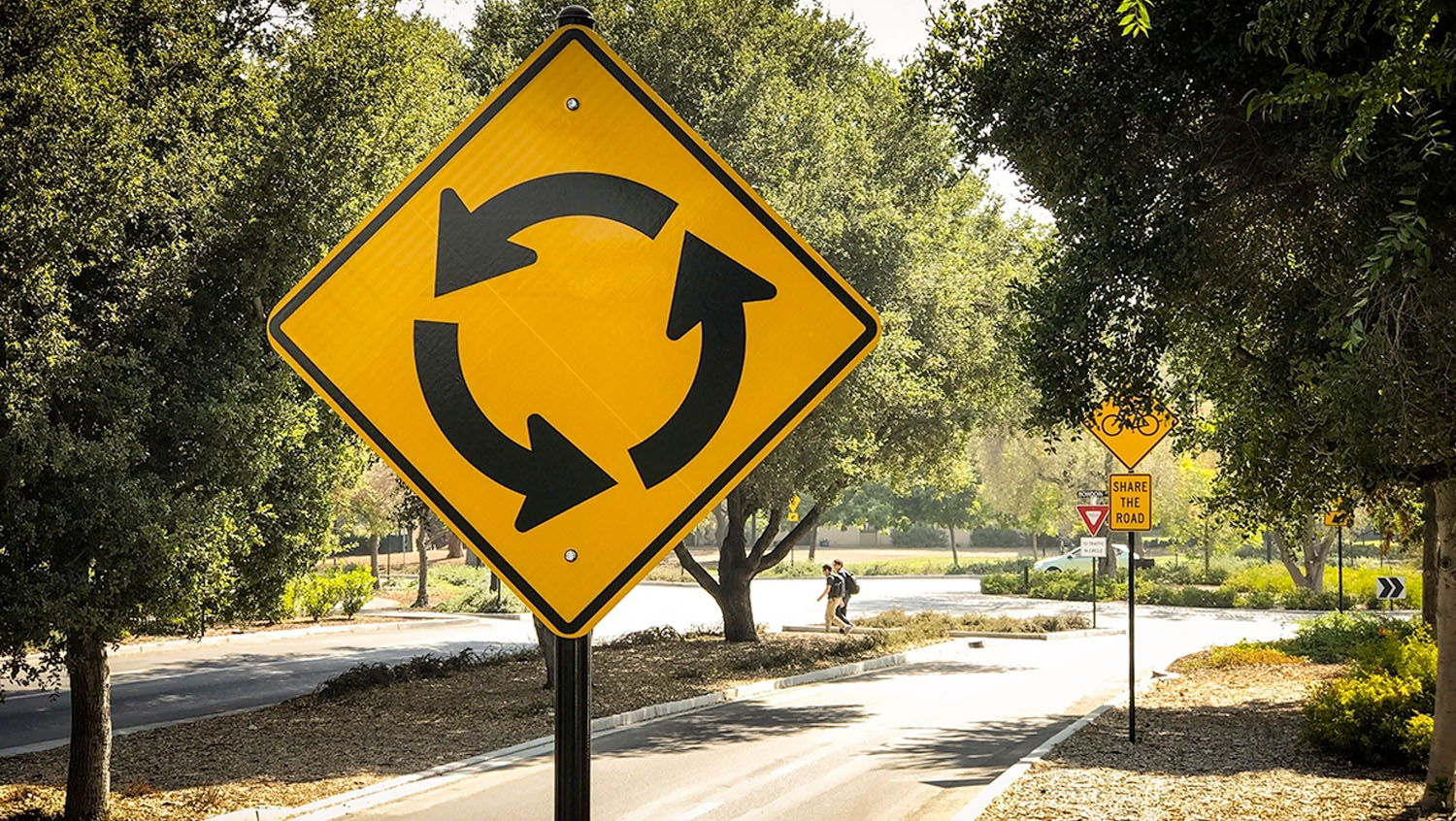
Don't get me wrong, clarity is not a bad thing. Working in a 'box like' organization can be more straightforward. Working in a 'sphere like' organization where there are less clear divisional lines and accountability (corners, straight edges) might pose more of a challenge. And recently I worked with a company who completed a very clear strategy. But the nature of their business could not account for the ongoing need for the Team to still operate with some ambiguity, so that too became part of their plan (captured as a value actually). So how could our execution benefit from embracing a little ambiguity? For that, let me explain how the difference between an intersection and a roundabout could help us.
A long time ago I studied Urban Planning, and one of my main areas of interest was transportation. And it was there that I came across a fascinating paradox. In North America, we tend to organize our road infrastructure to create 90-degree intersections and stop lights. Simple, right! The rules are clear - red means stop. Green means go. Yellow means 'run it' (only half-kidding). To support those rules we put up technology (stop lights) which are expensive to build let alone maintain. And then as motorists or pedestrians, we tend to shut our brains down and just follow the signals.
In Europe, they have embraced roundabouts. No technology needed to support. The rules are actually simple (car entering first has the right of way). Nobody needs to stop, but they do need to slow down and pay attention to the other cars (and bikes and pedestrians). If you've driven through one, you know that the discombobulating nature of the experience requires your full attention and a better level of coordination with other participants.
What might surprise you, however, is that the roundabout is a far superior method on every dimension. Although they can cost a bit more initially than a similar sized traffic signal intersection, they are cheaper to maintain and can function about 2.5 times longer before repairs They are safer by a wide margin, reducing traffic fatalities by up to 90% - no high speed head on or left turn collisions. And most surprising is that they actually can carry about 30% more traffic than a similar sized intersection during peak hours.
I'm not the first or only person to make this observation. But if we can learn to build in a 'roundabout' model and mindset in our organizations, focus on getting some clarity, but then allow people the space and trust to navigate and figure out the details, then perhaps we can get by with 'lower cost' policies and procedures and rely more on principles and judgement. We would definitely be managing less surface area and would have one heck of a force multiplier at work helping to power our strategy...and execution. Because it's all about getting the right things done.
We hope these 3 stories were helpful and got you reflecting on your own organization and some new lenses that might accelerate the execution of your strategic direction. In our work with many clients, the challenge of strategy execution is often the biggest hurdle. We are always on the lookout for shared experiences to get past those hurdles, so if you have insights to add please post what you've seen work.

Previous Story
The concept of surface area comes from Shane Parrish, who has an excellent podcast called the Knowledge Project.